

[Organisation] GUIDE FÜR DAS NEUE CURRICULUM - LEHRTAMT DEX/ KKP
Anhang 1: https://uni-ak.at/accounts/anhang/IKKK_2026_06_10_15_36_Guide_Neues_Curriculum_260603.pdf
Ab Oktober 2026 tritt das neue Lehramt-Curriculum in Kraft. Grund dafür ist eine Änderung im Universitätsgesetz (UG). Viele Elemente des bisherigen Studiums bleiben bestehen. Das Dokument im Anhang gibt einen Überblick über die wichtigsten Änderungen.
Für Fragen rund ums neue Curriculum:
Sprechstunde mit Anto und Teresa
Di. 09.06.2026 10:30-12:30 Uhr
Do. 18.06.2026 15:00-16:30 Uhr (hybrid)
Di. 23.06.2026 15:00-16:30 Uhr
Mo. 29.06.2026 11:30-13:00 Uhr
***
Dieses PDF enthält vorläufige Informationen zum neuen Curriculum auf Basis der ersten Lesung im Senat.
Alle Angaben erfolgen ohne Gewähr und können sich im weiteren Beschlussverfahren noch ändern.
Für Anrechnungen ist das Studiendekanat zuständig.
Quellen und weiterführende Links:
Hochschul-Qualitätssicherungsgesetz BGBI. I Nr. 74/2011 zuletzt geändert durch BGBI. I Nr. 50/2024, Inkrafttreten am 01.07.2024
Ab Oktober 2026 tritt das neue Lehramt-Curriculum in Kraft. Grund dafür ist eine Änderung im Universitätsgesetz (UG). Viele Elemente des bisherigen Studiums bleiben bestehen. Das Dokument im Anhang gibt einen Überblick über die wichtigsten Änderungen.
Für Fragen rund ums neue Curriculum:
Sprechstunde mit Anto und Teresa
Di. 09.06.2026 10:30-12:30 Uhr
Do. 18.06.2026 15:00-16:30 Uhr (hybrid)
Di. 23.06.2026 15:00-16:30 Uhr
Mo. 29.06.2026 11:30-13:00 Uhr
***
Dieses PDF enthält vorläufige Informationen zum neuen Curriculum auf Basis der ersten Lesung im Senat.
Alle Angaben erfolgen ohne Gewähr und können sich im weiteren Beschlussverfahren noch ändern.
Für Anrechnungen ist das Studiendekanat zuständig.
Quellen und weiterführende Links:
Hochschul-Qualitätssicherungsgesetz BGBI. I Nr. 74/2011 zuletzt geändert durch BGBI. I Nr. 50/2024, Inkrafttreten am 01.07.2024
[1. Studienjahr] ERINNERUNG: WERK_LABOR WISSEN W23, Termin 9. & 11.Juni:
Liebe Studierende,
Hier noch einmal der Hinweis, dass diese Woche das W_L_W Di und Do extra zählt!
Betrifft WERK_LABOR WISSEN W23, Termin 9. & 11.Juni:
Dienstag, 9.Juni WERK_LABOR WISSEN laut Kalender mit Basisinhalten zu Leder mit Heidelinde Zach
Donnerstag, 11.Juni wird IDA WESTH-HANSEN Leder von der künstlerischen Seite beleuchten, zB anhand ihrer Arbeiten im Artist in Residence Programm der L-AIR Foundation in Japan.
Das heißt: In der Woche 23 werden am Dienstag und Donnerstag jeweils unterschiedliche Inhalte besprochen.
-> es besteht keine Verpflichtung an beiden Terminen anwesend zu sein
-> für Studierende mit zu vielen Fehlzeiten eine Möglichkeit Termine aufzuholen
Lg Doris
Hier noch einmal der Hinweis, dass diese Woche das W_L_W Di und Do extra zählt!
Betrifft WERK_LABOR WISSEN W23, Termin 9. & 11.Juni:
Dienstag, 9.Juni WERK_LABOR WISSEN laut Kalender mit Basisinhalten zu Leder mit Heidelinde Zach
Donnerstag, 11.Juni wird IDA WESTH-HANSEN Leder von der künstlerischen Seite beleuchten, zB anhand ihrer Arbeiten im Artist in Residence Programm der L-AIR Foundation in Japan.
Das heißt: In der Woche 23 werden am Dienstag und Donnerstag jeweils unterschiedliche Inhalte besprochen.
-> es besteht keine Verpflichtung an beiden Terminen anwesend zu sein
-> für Studierende mit zu vielen Fehlzeiten eine Möglichkeit Termine aufzuholen
Lg Doris
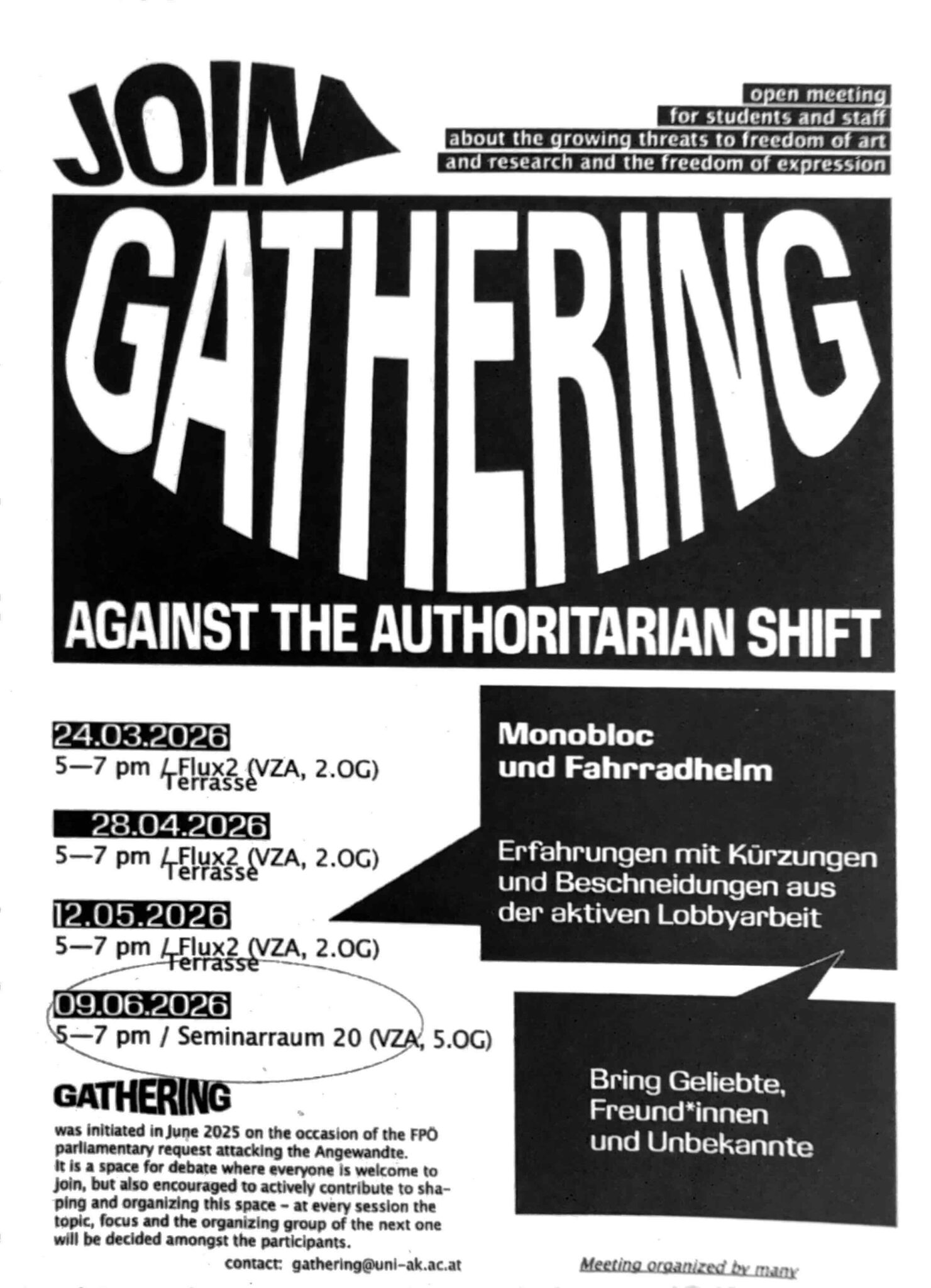
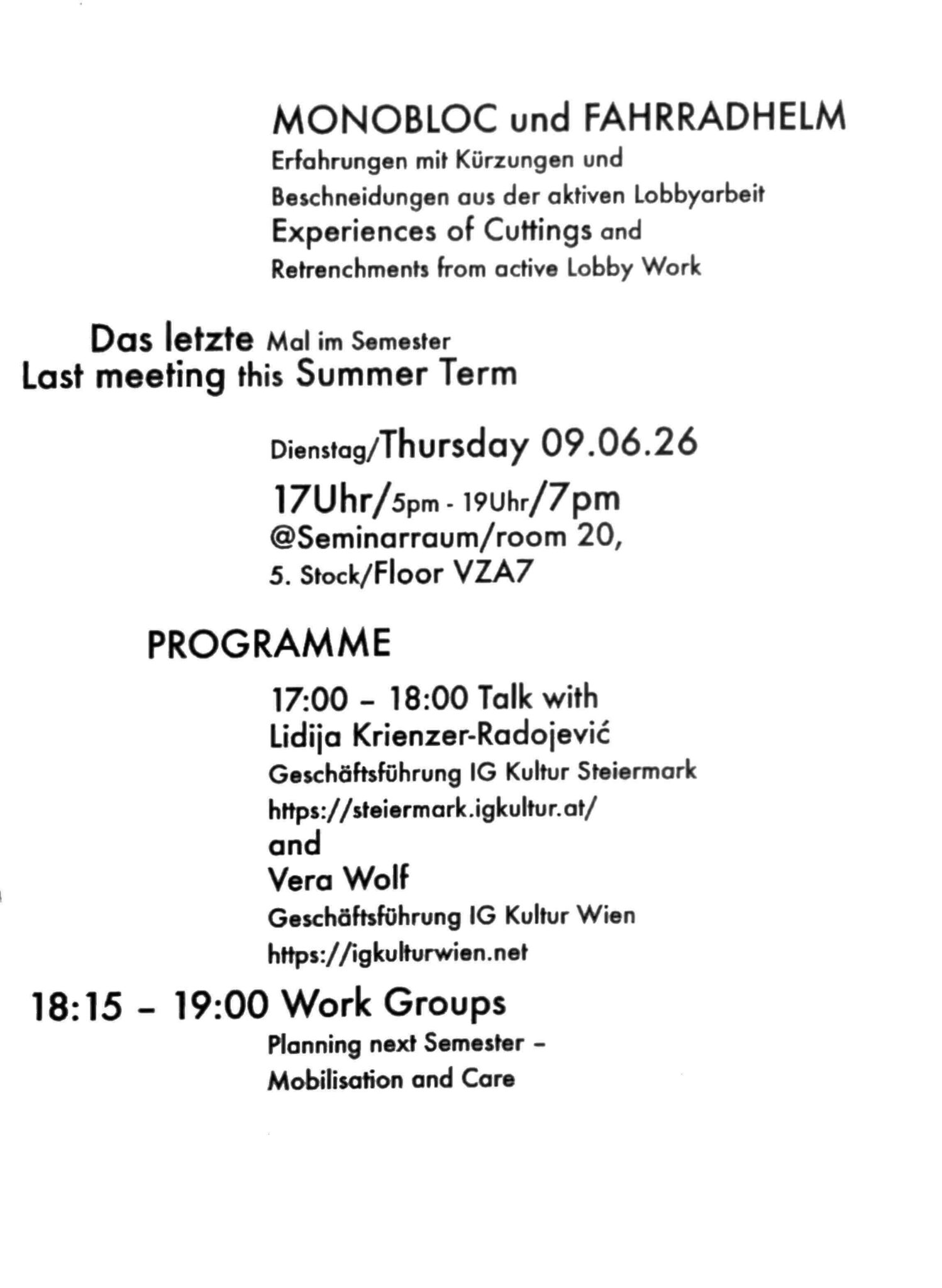
[Lehrveranstaltung] Gathering heute 9.6. SR20, 5.Stock - es geht um Erfahrungen mit Kürzungen
All welcome!! HEUTE!!
Gathering - Das letzte Mal im Semester/Last meeting this Summer Semester
🟪MONOBLOCK und FAHRRADHELM Erfahrungen mit Kürzungen und Beschneidungen aus der aktiven Lobbyarbeit/ Experiences of Cuttings and Retrenchments from active Lobby Work🟪
Dienstag/Thursday 09.06.26
17Uhr/5pm - 19Uhr/7pm
[at]Seminarraum/room 20,
5. Stock/Floor
VZA7
Anhang 1: https://uni-ak.at/accounts/anhang/IKKK_2026_06_09_14_41_Gathering_9.6.poster.jpg
Anhang 2: https://uni-ak.at/accounts/anhang/IKKK_2026_06_09_14_41_Gathering_9.6.Posterru__ckseite.jpg
Gathering - Das letzte Mal im Semester/Last meeting this Summer Semester
🟪MONOBLOCK und FAHRRADHELM Erfahrungen mit Kürzungen und Beschneidungen aus der aktiven Lobbyarbeit/ Experiences of Cuttings and Retrenchments from active Lobby Work🟪
Dienstag/Thursday 09.06.26
17Uhr/5pm - 19Uhr/7pm
[at]Seminarraum/room 20,
5. Stock/Floor
VZA7
Anhang 1: https://uni-ak.at/accounts/anhang/IKKK_2026_06_09_14_41_Gathering_9.6.poster.jpg
Anhang 2: https://uni-ak.at/accounts/anhang/IKKK_2026_06_09_14_41_Gathering_9.6.Posterru__ckseite.jpg
[Lehrveranstaltung] Portfoliotermin am 11.6. (Manora Auersperg) abgesagt
Der Portfolio-Termin am 11.6.2026 findet nicht statt.
Sollte noch Bedarf bestehen, kann ich am 24.6.2026 um 13.30 Uhr noch einen Termin anbieten. Bitte meldet euch ggf. bis spätestens 19.6. per mail bei mir an.
Liebe Grüße,
Manora Auersperg
manora.auersperg[at]uni-ak.ac.at
Sollte noch Bedarf bestehen, kann ich am 24.6.2026 um 13.30 Uhr noch einen Termin anbieten. Bitte meldet euch ggf. bis spätestens 19.6. per mail bei mir an.
Liebe Grüße,
Manora Auersperg
manora.auersperg[at]uni-ak.ac.at
[Lehrveranstaltung] Einladung zu den kommissionellen MA Prüfungen MI 24 JUNI 2026
Einladung zu den kommissionellen MA Prüfungen MI 24 JUNI 2026
Anhang 1: https://uni-ak.at/accounts/anhang/IKKK_2026_06_09_13_40_MA_Plakat_2026_JUNI_24.pdf
Anhang 1: https://uni-ak.at/accounts/anhang/IKKK_2026_06_09_13_40_MA_Plakat_2026_JUNI_24.pdf
[Job] An der AHS Korneuburg wird für das Schuljahr 2026/27 eine Lehrkraft für ca. 8 Stunden KG und 9 Stunden TD gesucht
An der AHS Korneuburg wird für das Schuljahr 2026/27 eine Lehrkraft für ca. 8 Stunden KG und 9 Stunden TD gesucht.
Bei Interesse bitte direkt an die Direktion schreiben: direktion[at]ahs-korneuburg.at
mit freundlichen Grüßen
Ella Wagner
Bei Interesse bitte direkt an die Direktion schreiben: direktion[at]ahs-korneuburg.at
mit freundlichen Grüßen
Ella Wagner
[Veranstaltung] Buchvorstellung "Äußerung des Denkens. Marx, Freud, Kant, Hegel", Robert Pfaller im Gespräch mit Jan Völker, Mittwoch, 10.6.2026, 20:00 Uhr, Aux Gazelles Rahlgasse 5, 1060 Wien
Buchvorstellung
Robert Pfaller im Gespräch mit Jan Völker
Über "Äußerung des Denkens. Marx, Freud, Kant, Hegel"
(Wien: Turia + Kant 2026)
Mittwoch, 10.6.2026
20:00 Uhr
Aux Gazelles
Rahlgasse 5
1060 Wien
Die Abteilung Philosophie lädt herzlich ein zur Buchvorstellung "Äußerungen des Denkens. Marx, Freud, Kann, Hegel" von Jan Völker.
Das Buch führt in einem »spekulativen Quartett« (Badiou) das Denken von Marx, Freud, Kant und Hegel zusammen, um es als einen übergreifenden, geteilten Prozess zu begreifen. Dieses Denken gehorcht weder einer vorausgesetzten Idee, noch arbeitet es im Auftrag einer übergreifenden Idee – das Denken wird zu einem Selben, das sich durch die Verschiedenheiten entwickelt. So entwirft Marx gegen den Junghegelianismus einen anderen ›Hegel‹. Freud treibt das Unbewusste aus einem inneren Abstand der Transzendentalphilosophie Kants hervor. Das Denken äußert sich, indem als das Verschiedene eines Selben erscheint. »Ein wirklich tiefgreifendes Unterfangen, das tatsächlich das gesamte Verfahren der Philosophien betrifft.« (Alain Badiou)
Robert Pfaller
Professor für Philosophie an der Kunstuniversität Linz. Veröffentlichungen u. a.: Klare Striche zu wunden Punkten (2026). Das Lachen der Ungetäuschten. Die philosophische Würde der Komödie (2025). Die blitzenden Waffen. Über die Macht der Form (2020, alle S. Fischer Verlag)
Jan Völker
Professor für Philosophie an der Universität für angewandte Kunst Wien. Veröffentlichungen u.a.: Ein Weltall des Kapitals. Die Überwindung der terrestrischen Vernunft (2025), Äußerung des Denkens. Marx, Freud, Kant, Hegel (2026)
Anhang 1: https://uni-ak.at/accounts/anhang/IKKK_2026_06_08_13_16_Plakat_Buchpr__sentation_Jan_V__lker_10.6.2026_dig.pdf
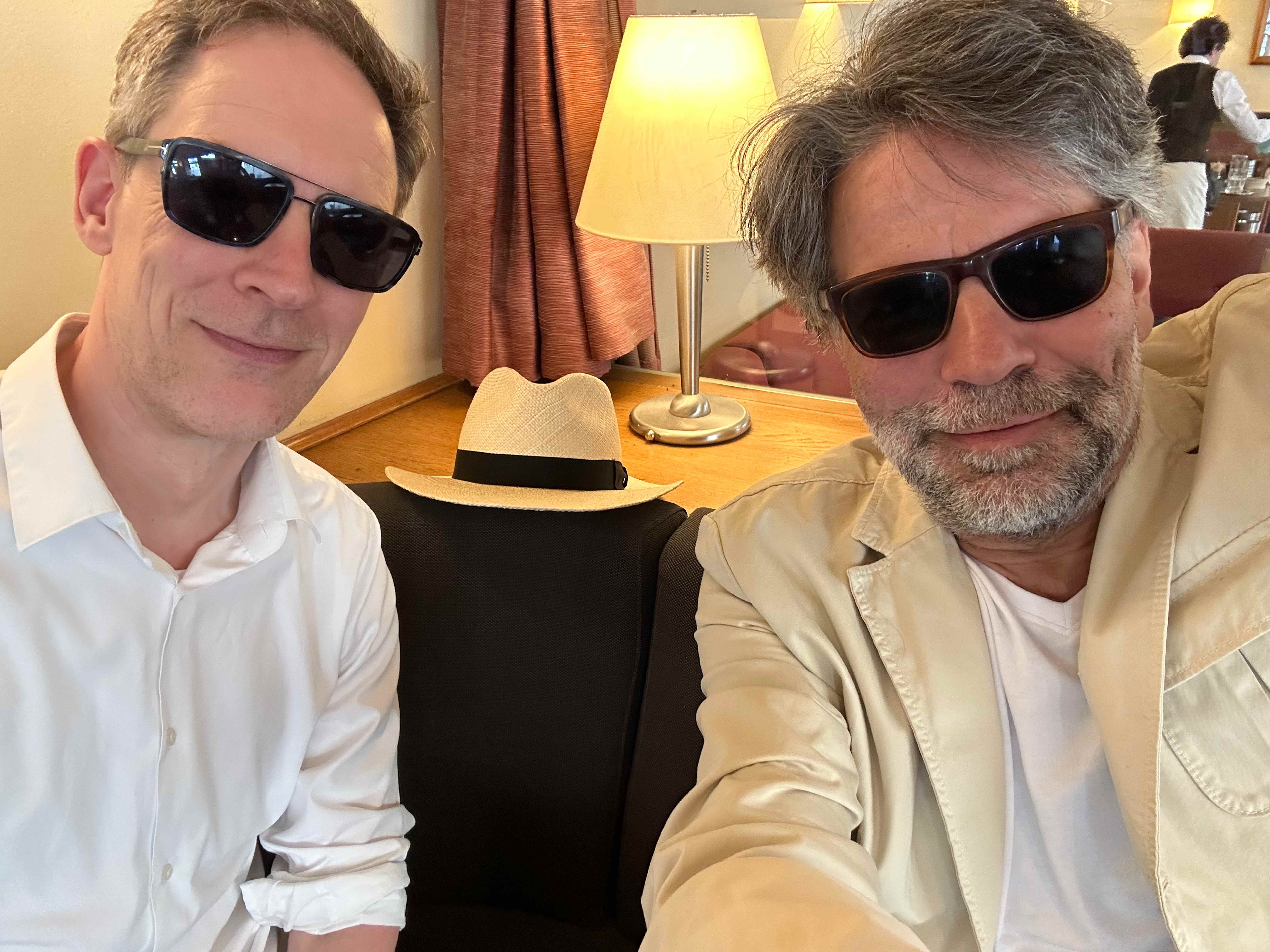
Anhang 2: https://uni-ak.at/accounts/anhang/IKKK_2026_06_08_13_16_Foto_Jan_V__lker_mit_Robert_Pfaller_Mai_2026_kl.jpg
Robert Pfaller im Gespräch mit Jan Völker
Über "Äußerung des Denkens. Marx, Freud, Kant, Hegel"
(Wien: Turia + Kant 2026)
Mittwoch, 10.6.2026
20:00 Uhr
Aux Gazelles
Rahlgasse 5
1060 Wien
Die Abteilung Philosophie lädt herzlich ein zur Buchvorstellung "Äußerungen des Denkens. Marx, Freud, Kann, Hegel" von Jan Völker.
Das Buch führt in einem »spekulativen Quartett« (Badiou) das Denken von Marx, Freud, Kant und Hegel zusammen, um es als einen übergreifenden, geteilten Prozess zu begreifen. Dieses Denken gehorcht weder einer vorausgesetzten Idee, noch arbeitet es im Auftrag einer übergreifenden Idee – das Denken wird zu einem Selben, das sich durch die Verschiedenheiten entwickelt. So entwirft Marx gegen den Junghegelianismus einen anderen ›Hegel‹. Freud treibt das Unbewusste aus einem inneren Abstand der Transzendentalphilosophie Kants hervor. Das Denken äußert sich, indem als das Verschiedene eines Selben erscheint. »Ein wirklich tiefgreifendes Unterfangen, das tatsächlich das gesamte Verfahren der Philosophien betrifft.« (Alain Badiou)
Robert Pfaller
Professor für Philosophie an der Kunstuniversität Linz. Veröffentlichungen u. a.: Klare Striche zu wunden Punkten (2026). Das Lachen der Ungetäuschten. Die philosophische Würde der Komödie (2025). Die blitzenden Waffen. Über die Macht der Form (2020, alle S. Fischer Verlag)
Jan Völker
Professor für Philosophie an der Universität für angewandte Kunst Wien. Veröffentlichungen u.a.: Ein Weltall des Kapitals. Die Überwindung der terrestrischen Vernunft (2025), Äußerung des Denkens. Marx, Freud, Kant, Hegel (2026)
Anhang 1: https://uni-ak.at/accounts/anhang/IKKK_2026_06_08_13_16_Plakat_Buchpr__sentation_Jan_V__lker_10.6.2026_dig.pdf
Anhang 2: https://uni-ak.at/accounts/anhang/IKKK_2026_06_08_13_16_Foto_Jan_V__lker_mit_Robert_Pfaller_Mai_2026_kl.jpg
[Lehrveranstaltung] SE/EX Paris: „Paris blickt auf die Welt. Kunst, Imperium und Wissenschaft 1766–2026“
Liebe Studierende, dear students (english below)
die Abteilung Kunstgeschichte veranstaltet im Wintersemester 2026/27 im Co-Teaching von Anita Hosseini und Eva Kernbauer das Seminar „Paris blickt auf die Welt. Kunst, Imperium und Wissenschaft 1766–2026“. Diese Lehrveranstaltung besteht aus drei Treffen in Wien und einer einer Exkursion vom 08.–13. November 2026 nach Paris, über die wir aus organisatorischen Gründen bereits jetzt informieren.
Exkursionsdaten: 08.–13. November 2026
Seminardaten: jeweils Donnerstag, 10:00-11:45 bzw. 10:00-13:30:
Do. 01.10.2026 von 10:00–11:45
Do. 15.10.2026 von 10:00–13:30
Do. 19.11.2026 von 10:00–11:45
Exkursion und Seminar können nur gemeinsam belegt werden.
Im Zentrum der Lehrveranstaltung steht die französische Kunst der Moderne und Gegenwart aus kolonialen und dekolonialenPerspektiven. Untersucht werden dabei unter anderem das Spannungsverhältnis von Republik und Empire, imperiale und koloniale Sammlungspolitiken sowie Prozesse kultureller Zirkulation. Weitere Schwerpunkte bilden Fragen von Geschlecht, race, Klasse und Intersektionalität, machtkritische Ansätze sowie Orientalismus. Anhand von Kunst-, Museums- und Ausstellungsbesuchen möchten wir das imperiale worldmaking Frankreichs und seine bis in die Gegenwart reichenden Repräsentationsformen untersuchen.
Während der Exkursion werden wir uns vor Ort mit Institutionen, ihren Repräsentationsweisen und ihrer Geschichte auseinandersetzen sowie Ausstellungs- und Sammlungspraktiken machtkritisch hinterfragen. Neben Museums- und Bibliotheksbesuchen ist auch ein Ausflug nach Malmaison, dem imperialen Garten Joséphine Bonapartes, geplant. Zudem möchten wir mit den Kolleg:innen des Deutschen Forums für Kunstgeschichte/Centre allemand d’histoire de l’art in Austausch treten und das Forschungsinstitut sowie seine Angebote kennenlernen.
Teilnahmebedingungen:
Vorbereitung einer Textmoderation zur gemeinsamen Textdiskussion im Seminar,
Übernahme einer Objekt-/Werk-/Ortsbesprechung in Paris,
vollständige Teilnahme an den Seminarsitzungen und an allen Exkursionstagen,
Selbstorganisation der Hin- (8.11.) und Rückreise (13.11.) nach/von Paris,
Selbstbehalt von EUR 50,00 (nach Bestätigung der Anmeldung im Sekretariat der Abteilung Kunstgeschichte hinterlegen: VZA 7, 4. Stock, Zimmer 445).
Die ausführliche LV-Beschreibung ist ab Mitte Juli in der Base freigeschaltet.
Bei Interesse bitte um Anmeldung bis 30.06.2026 bei anita.hosseini[at]uni-ak.ac.at und eva.kernbauer[at]uni-ak.ac.at mit den folgenden Angaben:
Betreff: „SE und EX Paris“
Name
Klasse/Studienfach
Telefonnummer und Email-Adresse
Kurzes Statement zum Interesse an den Inhalten der Lehrveranstaltung sowie an der Exkursion (4-5 Sätze)
Scan eines Reisedokuments: Pass/Personalausweis/alternatives Reisedokument. Achtung auf Gültigkeit im November 2026!
Wir geben bis 13. Juli 2026 Bescheid, ob die Teilnahme möglich ist.
Sobald die Anmeldung bestätigt ist, kann die Reise gebucht werden. Bitte achtet dabei auf diese Daten: Anreise am 08. November, Beginn der Exkursion in Paris am 09. November, 9:30, Ende der Exkursion: Freitag, 13. November, 15:00.
Selbstbehalt: Hin- und Rückreise nach/von Paris, Verpflegung vor Ort, Anzahlung von EUR 50,00.
Die Universität übernimmt Unterkunft (inkl. Frühstück) in Paris von Sonntag, 08.11. bis Freitag 13.11., Eintritte, öffentliche Verkehrsmittel und allfällige weitere Kosten.
Die Anzahl der Teilnehmer:innen ist auf 12 Personen beschränkt.
Herzliche Grüße
Anita Hosseini und Eva Kernbauer
————————————————————————————
Dear Students,
The Department of Art History will offer the seminar "Paris Looks at the World: Art, Empire and Science 1766–2026" in fall/winter 2026/27, jointly taught by Anita Hosseini and Eva Kernbauer. The course consists of three meetings in Vienna and an excursion to Paris from 8–13 November 2026, about which we would like to inform you already at this stage for organizational reasons.
Excursion dates: 8–13 November 2026
Seminar dates: Thursdays, 10:00–11:45 or 10:00–13:30 respectively:
Thu, 1 October 2026, 10:00–11:45
Thu, 15 October 2026, 10:00–13:30
Thu, 19 November 2026, 10:00–11:45
The excursion and the seminar can only be taken together.
The course focuses on French modern and contemporary art from colonial and decolonial perspectives. Among other topics, we will examine the tensions between Republic and Empire, imperial and colonial collecting policies, and processes of cultural circulation. Additional focal points include questions of gender, race, class, and intersectionality, power-critical approaches, as well as Orientalism. Through visits to museums, and exhibitions, we aim to investigate France’s imperial worldmaking and its forms of representation that continue into the present.
During the excursion, we will engage with institutions on site, their modes of representation, and their histories, while critically examining exhibition and collecting practices through a power-critical lens. In addition to museum and library visits, an excursion to Malmaison, the imperial garden of Joséphine Bonaparte, is planned. We also intend to meet with colleagues at the German Center for Art History (Centre allemand d’histoire de l’art) and aim to learn more about the research institute and its activities.
Requirements for participation:
Preparation and moderation of a reading for the joint seminar discussion (15.10.),
Presentation of an object, artwork, or site in Paris,
Full participation in all seminar sessions and throughout the entire excursion,
Independent organization of travel to Paris (8 November) and return travel from Paris (13 November),
A personal contribution of EUR 50.00 (to be deposited with the Department of Art History office after confirmation of registration: VZA 7, 4th floor, room 445).
The detailed course description will be available in base from mid-July onwards.
If you are interested, please register by 30 June 2026 by emailing anita.hosseini[at]uni-ak.ac.at and eva.kernbauer[at]uni-ak.ac.at, with the following information:
Subject line: “SE and EX Paris”
Name
Class/degree programme
Telephone number and email address
A brief statement explaining your interest in the course content and the excursion (4–5 sentences)
A scan of a travel document: passport, identity card, or alternative travel document. Please ensure that the document remains valid in November 2026.
We will inform you by 13 July 2026 whether participation is possible.
Once your registration has been confirmed, you may book your travel. Please note the following dates: arrival on 8 November; start of the excursion in Paris on 9 November at 9:30; end of the excursion on Friday, 13 November at 15:00.
Personal expenses: travel to and from Paris, meals during the excursion, and the EUR 50.00 contribution.
The university will cover accommodation (including breakfast) in Paris from Sunday, 8 November, to Friday, 13 November, admission fees, public transportation, and any additional costs that may arise.
The number of participants is limited to 12.
Kind regards,
Anita Hosseini & Eva Kernbauer
die Abteilung Kunstgeschichte veranstaltet im Wintersemester 2026/27 im Co-Teaching von Anita Hosseini und Eva Kernbauer das Seminar „Paris blickt auf die Welt. Kunst, Imperium und Wissenschaft 1766–2026“. Diese Lehrveranstaltung besteht aus drei Treffen in Wien und einer einer Exkursion vom 08.–13. November 2026 nach Paris, über die wir aus organisatorischen Gründen bereits jetzt informieren.
Exkursionsdaten: 08.–13. November 2026
Seminardaten: jeweils Donnerstag, 10:00-11:45 bzw. 10:00-13:30:
Do. 01.10.2026 von 10:00–11:45
Do. 15.10.2026 von 10:00–13:30
Do. 19.11.2026 von 10:00–11:45
Exkursion und Seminar können nur gemeinsam belegt werden.
Im Zentrum der Lehrveranstaltung steht die französische Kunst der Moderne und Gegenwart aus kolonialen und dekolonialenPerspektiven. Untersucht werden dabei unter anderem das Spannungsverhältnis von Republik und Empire, imperiale und koloniale Sammlungspolitiken sowie Prozesse kultureller Zirkulation. Weitere Schwerpunkte bilden Fragen von Geschlecht, race, Klasse und Intersektionalität, machtkritische Ansätze sowie Orientalismus. Anhand von Kunst-, Museums- und Ausstellungsbesuchen möchten wir das imperiale worldmaking Frankreichs und seine bis in die Gegenwart reichenden Repräsentationsformen untersuchen.
Während der Exkursion werden wir uns vor Ort mit Institutionen, ihren Repräsentationsweisen und ihrer Geschichte auseinandersetzen sowie Ausstellungs- und Sammlungspraktiken machtkritisch hinterfragen. Neben Museums- und Bibliotheksbesuchen ist auch ein Ausflug nach Malmaison, dem imperialen Garten Joséphine Bonapartes, geplant. Zudem möchten wir mit den Kolleg:innen des Deutschen Forums für Kunstgeschichte/Centre allemand d’histoire de l’art in Austausch treten und das Forschungsinstitut sowie seine Angebote kennenlernen.
Teilnahmebedingungen:
Vorbereitung einer Textmoderation zur gemeinsamen Textdiskussion im Seminar,
Übernahme einer Objekt-/Werk-/Ortsbesprechung in Paris,
vollständige Teilnahme an den Seminarsitzungen und an allen Exkursionstagen,
Selbstorganisation der Hin- (8.11.) und Rückreise (13.11.) nach/von Paris,
Selbstbehalt von EUR 50,00 (nach Bestätigung der Anmeldung im Sekretariat der Abteilung Kunstgeschichte hinterlegen: VZA 7, 4. Stock, Zimmer 445).
Die ausführliche LV-Beschreibung ist ab Mitte Juli in der Base freigeschaltet.
Bei Interesse bitte um Anmeldung bis 30.06.2026 bei anita.hosseini[at]uni-ak.ac.at und eva.kernbauer[at]uni-ak.ac.at mit den folgenden Angaben:
Betreff: „SE und EX Paris“
Name
Klasse/Studienfach
Telefonnummer und Email-Adresse
Kurzes Statement zum Interesse an den Inhalten der Lehrveranstaltung sowie an der Exkursion (4-5 Sätze)
Scan eines Reisedokuments: Pass/Personalausweis/alternatives Reisedokument. Achtung auf Gültigkeit im November 2026!
Wir geben bis 13. Juli 2026 Bescheid, ob die Teilnahme möglich ist.
Sobald die Anmeldung bestätigt ist, kann die Reise gebucht werden. Bitte achtet dabei auf diese Daten: Anreise am 08. November, Beginn der Exkursion in Paris am 09. November, 9:30, Ende der Exkursion: Freitag, 13. November, 15:00.
Selbstbehalt: Hin- und Rückreise nach/von Paris, Verpflegung vor Ort, Anzahlung von EUR 50,00.
Die Universität übernimmt Unterkunft (inkl. Frühstück) in Paris von Sonntag, 08.11. bis Freitag 13.11., Eintritte, öffentliche Verkehrsmittel und allfällige weitere Kosten.
Die Anzahl der Teilnehmer:innen ist auf 12 Personen beschränkt.
Herzliche Grüße
Anita Hosseini und Eva Kernbauer
————————————————————————————
Dear Students,
The Department of Art History will offer the seminar "Paris Looks at the World: Art, Empire and Science 1766–2026" in fall/winter 2026/27, jointly taught by Anita Hosseini and Eva Kernbauer. The course consists of three meetings in Vienna and an excursion to Paris from 8–13 November 2026, about which we would like to inform you already at this stage for organizational reasons.
Excursion dates: 8–13 November 2026
Seminar dates: Thursdays, 10:00–11:45 or 10:00–13:30 respectively:
Thu, 1 October 2026, 10:00–11:45
Thu, 15 October 2026, 10:00–13:30
Thu, 19 November 2026, 10:00–11:45
The excursion and the seminar can only be taken together.
The course focuses on French modern and contemporary art from colonial and decolonial perspectives. Among other topics, we will examine the tensions between Republic and Empire, imperial and colonial collecting policies, and processes of cultural circulation. Additional focal points include questions of gender, race, class, and intersectionality, power-critical approaches, as well as Orientalism. Through visits to museums, and exhibitions, we aim to investigate France’s imperial worldmaking and its forms of representation that continue into the present.
During the excursion, we will engage with institutions on site, their modes of representation, and their histories, while critically examining exhibition and collecting practices through a power-critical lens. In addition to museum and library visits, an excursion to Malmaison, the imperial garden of Joséphine Bonaparte, is planned. We also intend to meet with colleagues at the German Center for Art History (Centre allemand d’histoire de l’art) and aim to learn more about the research institute and its activities.
Requirements for participation:
Preparation and moderation of a reading for the joint seminar discussion (15.10.),
Presentation of an object, artwork, or site in Paris,
Full participation in all seminar sessions and throughout the entire excursion,
Independent organization of travel to Paris (8 November) and return travel from Paris (13 November),
A personal contribution of EUR 50.00 (to be deposited with the Department of Art History office after confirmation of registration: VZA 7, 4th floor, room 445).
The detailed course description will be available in base from mid-July onwards.
If you are interested, please register by 30 June 2026 by emailing anita.hosseini[at]uni-ak.ac.at and eva.kernbauer[at]uni-ak.ac.at, with the following information:
Subject line: “SE and EX Paris”
Name
Class/degree programme
Telephone number and email address
A brief statement explaining your interest in the course content and the excursion (4–5 sentences)
A scan of a travel document: passport, identity card, or alternative travel document. Please ensure that the document remains valid in November 2026.
We will inform you by 13 July 2026 whether participation is possible.
Once your registration has been confirmed, you may book your travel. Please note the following dates: arrival on 8 November; start of the excursion in Paris on 9 November at 9:30; end of the excursion on Friday, 13 November at 15:00.
Personal expenses: travel to and from Paris, meals during the excursion, and the EUR 50.00 contribution.
The university will cover accommodation (including breakfast) in Paris from Sunday, 8 November, to Friday, 13 November, admission fees, public transportation, and any additional costs that may arise.
The number of participants is limited to 12.
Kind regards,
Anita Hosseini & Eva Kernbauer
[Lehrveranstaltung] SE/EX Pari: „Paris blickt auf die Welt. Kunst, Imperium und Wissenschaft 1766–2026“
Liebe Studierende, dear students (english below)
die Abteilung Kunstgeschichte veranstaltet im Wintersemester 2026/27 im Co-Teaching von Anita Hosseini und Eva Kernbauer das Seminar „Paris blickt auf die Welt. Kunst, Imperium und Wissenschaft 1766–2026“. Diese Lehrveranstaltung besteht aus drei Treffen in Wien und einer einer Exkursion vom 08.–13. November 2026 nach Paris, über die wir aus organisatorischen Gründen bereits jetzt informieren.
Exkursionsdaten: 08.–13. November 2026
Seminardaten: jeweils Donnerstag, 10:00-11:45 bzw. 10:00-13:30:
Do. 01.10.2026 von 10:00–11:45
Do. 15.10.2026 von 10:00–13:30
Do. 19.11.2026 von 10:00–11:45
Exkursion und Seminar können nur gemeinsam belegt werden.
Im Zentrum der Lehrveranstaltung steht die französische Kunst der Moderne und Gegenwart aus kolonialen und dekolonialenPerspektiven. Untersucht werden dabei unter anderem das Spannungsverhältnis von Republik und Empire, imperiale und koloniale Sammlungspolitiken sowie Prozesse kultureller Zirkulation. Weitere Schwerpunkte bilden Fragen von Geschlecht, race, Klasse und Intersektionalität, machtkritische Ansätze sowie Orientalismus. Anhand von Kunst-, Museums- und Ausstellungsbesuchen möchten wir das imperiale worldmaking Frankreichs und seine bis in die Gegenwart reichenden Repräsentationsformen untersuchen.
Während der Exkursion werden wir uns vor Ort mit Institutionen, ihren Repräsentationsweisen und ihrer Geschichte auseinandersetzen sowie Ausstellungs- und Sammlungspraktiken machtkritisch hinterfragen. Neben Museums- und Bibliotheksbesuchen ist auch ein Ausflug nach Malmaison, dem imperialen Garten Joséphine Bonapartes, geplant. Zudem möchten wir mit den Kolleg:innen des Deutschen Forums für Kunstgeschichte/Centre allemand d’histoire de l’art in Austausch treten und das Forschungsinstitut sowie seine Angebote kennenlernen.
Teilnahmebedingungen:
Vorbereitung einer Textmoderation zur gemeinsamen Textdiskussion im Seminar,
Übernahme einer Objekt-/Werk-/Ortsbesprechung in Paris,
vollständige Teilnahme an den Seminarsitzungen und an allen Exkursionstagen,
Selbstorganisation der Hin- (8.11.) und Rückreise (13.11.) nach/von Paris,
Selbstbehalt von EUR 50,00 (nach Bestätigung der Anmeldung im Sekretariat der Abteilung Kunstgeschichte hinterlegen: VZA 7, 4. Stock, Zimmer 445).
Die ausführliche LV-Beschreibung ist ab Mitte Juli in der Base freigeschaltet.
Bei Interesse bitte um Anmeldung bis 30.06.2026 bei anita.hosseini[at]uni-ak.ac.at und eva.kernbauer[at]uni-ak.ac.at mit den folgenden Angaben:
Betreff: „SE und EX Paris“
Name
Klasse/Studienfach
Telefonnummer und Email-Adresse
Kurzes Statement zum Interesse an den Inhalten der Lehrveranstaltung sowie an der Exkursion (4-5 Sätze)
Scan eines Reisedokuments: Pass/Personalausweis/alternatives Reisedokument. Achtung auf Gültigkeit im November 2026!
Wir geben bis 13. Juli 2026 Bescheid, ob die Teilnahme möglich ist.
Sobald die Anmeldung bestätigt ist, kann die Reise gebucht werden. Bitte achtet dabei auf diese Daten: Anreise am 08. November, Beginn der Exkursion in Paris am 09. November, 9:30, Ende der Exkursion: Freitag, 13. November, 15:00.
Selbstbehalt: Hin- und Rückreise nach/von Paris, Verpflegung vor Ort, Anzahlung von EUR 50,00.
Die Universität übernimmt Unterkunft (inkl. Frühstück) in Paris von Sonntag, 08.11. bis Freitag 13.11., Eintritte, öffentliche Verkehrsmittel und allfällige weitere Kosten.
Die Anzahl der Teilnehmer:innen ist auf 12 Personen beschränkt.
Herzliche Grüße
Anita Hosseini und Eva Kernbauer
————————————————————————————
Dear Students,
The Department of Art History will offer the seminar "Paris Looks at the World: Art, Empire and Science 1766–2026" in fall/winter 2026/27, jointly taught by Anita Hosseini and Eva Kernbauer. The course consists of three meetings in Vienna and an excursion to Paris from 8–13 November 2026, about which we would like to inform you already at this stage for organizational reasons.
Excursion dates: 8–13 November 2026
Seminar dates: Thursdays, 10:00–11:45 or 10:00–13:30 respectively:
Thu, 1 October 2026, 10:00–11:45
Thu, 15 October 2026, 10:00–13:30
Thu, 19 November 2026, 10:00–11:45
The excursion and the seminar can only be taken together.
The course focuses on French modern and contemporary art from colonial and decolonial perspectives. Among other topics, we will examine the tensions between Republic and Empire, imperial and colonial collecting policies, and processes of cultural circulation. Additional focal points include questions of gender, race, class, and intersectionality, power-critical approaches, as well as Orientalism. Through visits to museums, and exhibitions, we aim to investigate France’s imperial worldmaking and its forms of representation that continue into the present.
During the excursion, we will engage with institutions on site, their modes of representation, and their histories, while critically examining exhibition and collecting practices through a power-critical lens. In addition to museum and library visits, an excursion to Malmaison, the imperial garden of Joséphine Bonaparte, is planned. We also intend to meet with colleagues at the German Center for Art History (Centre allemand d’histoire de l’art) and aim to learn more about the research institute and its activities.
Requirements for participation:
Preparation and moderation of a reading for the joint seminar discussion (15.10.),
Presentation of an object, artwork, or site in Paris,
Full participation in all seminar sessions and throughout the entire excursion,
Independent organization of travel to Paris (8 November) and return travel from Paris (13 November),
A personal contribution of EUR 50.00 (to be deposited with the Department of Art History office after confirmation of registration: VZA 7, 4th floor, room 445).
The detailed course description will be available in base from mid-July onwards.
If you are interested, please register by 30 June 2026 by emailing anita.hosseini[at]uni-ak.ac.at and eva.kernbauer[at]uni-ak.ac.at, with the following information:
Subject line: “SE and EX Paris”
Name
Class/degree programme
Telephone number and email address
A brief statement explaining your interest in the course content and the excursion (4–5 sentences)
A scan of a travel document: passport, identity card, or alternative travel document. Please ensure that the document remains valid in November 2026.
We will inform you by 13 July 2026 whether participation is possible.
Once your registration has been confirmed, you may book your travel. Please note the following dates: arrival on 8 November; start of the excursion in Paris on 9 November at 9:30; end of the excursion on Friday, 13 November at 15:00.
Personal expenses: travel to and from Paris, meals during the excursion, and the EUR 50.00 contribution.
The university will cover accommodation (including breakfast) in Paris from Sunday, 8 November, to Friday, 13 November, admission fees, public transportation, and any additional costs that may arise.
The number of participants is limited to 12.
Kind regards,
Anita Hosseini & Eva Kernbauer
die Abteilung Kunstgeschichte veranstaltet im Wintersemester 2026/27 im Co-Teaching von Anita Hosseini und Eva Kernbauer das Seminar „Paris blickt auf die Welt. Kunst, Imperium und Wissenschaft 1766–2026“. Diese Lehrveranstaltung besteht aus drei Treffen in Wien und einer einer Exkursion vom 08.–13. November 2026 nach Paris, über die wir aus organisatorischen Gründen bereits jetzt informieren.
Exkursionsdaten: 08.–13. November 2026
Seminardaten: jeweils Donnerstag, 10:00-11:45 bzw. 10:00-13:30:
Do. 01.10.2026 von 10:00–11:45
Do. 15.10.2026 von 10:00–13:30
Do. 19.11.2026 von 10:00–11:45
Exkursion und Seminar können nur gemeinsam belegt werden.
Im Zentrum der Lehrveranstaltung steht die französische Kunst der Moderne und Gegenwart aus kolonialen und dekolonialenPerspektiven. Untersucht werden dabei unter anderem das Spannungsverhältnis von Republik und Empire, imperiale und koloniale Sammlungspolitiken sowie Prozesse kultureller Zirkulation. Weitere Schwerpunkte bilden Fragen von Geschlecht, race, Klasse und Intersektionalität, machtkritische Ansätze sowie Orientalismus. Anhand von Kunst-, Museums- und Ausstellungsbesuchen möchten wir das imperiale worldmaking Frankreichs und seine bis in die Gegenwart reichenden Repräsentationsformen untersuchen.
Während der Exkursion werden wir uns vor Ort mit Institutionen, ihren Repräsentationsweisen und ihrer Geschichte auseinandersetzen sowie Ausstellungs- und Sammlungspraktiken machtkritisch hinterfragen. Neben Museums- und Bibliotheksbesuchen ist auch ein Ausflug nach Malmaison, dem imperialen Garten Joséphine Bonapartes, geplant. Zudem möchten wir mit den Kolleg:innen des Deutschen Forums für Kunstgeschichte/Centre allemand d’histoire de l’art in Austausch treten und das Forschungsinstitut sowie seine Angebote kennenlernen.
Teilnahmebedingungen:
Vorbereitung einer Textmoderation zur gemeinsamen Textdiskussion im Seminar,
Übernahme einer Objekt-/Werk-/Ortsbesprechung in Paris,
vollständige Teilnahme an den Seminarsitzungen und an allen Exkursionstagen,
Selbstorganisation der Hin- (8.11.) und Rückreise (13.11.) nach/von Paris,
Selbstbehalt von EUR 50,00 (nach Bestätigung der Anmeldung im Sekretariat der Abteilung Kunstgeschichte hinterlegen: VZA 7, 4. Stock, Zimmer 445).
Die ausführliche LV-Beschreibung ist ab Mitte Juli in der Base freigeschaltet.
Bei Interesse bitte um Anmeldung bis 30.06.2026 bei anita.hosseini[at]uni-ak.ac.at und eva.kernbauer[at]uni-ak.ac.at mit den folgenden Angaben:
Betreff: „SE und EX Paris“
Name
Klasse/Studienfach
Telefonnummer und Email-Adresse
Kurzes Statement zum Interesse an den Inhalten der Lehrveranstaltung sowie an der Exkursion (4-5 Sätze)
Scan eines Reisedokuments: Pass/Personalausweis/alternatives Reisedokument. Achtung auf Gültigkeit im November 2026!
Wir geben bis 13. Juli 2026 Bescheid, ob die Teilnahme möglich ist.
Sobald die Anmeldung bestätigt ist, kann die Reise gebucht werden. Bitte achtet dabei auf diese Daten: Anreise am 08. November, Beginn der Exkursion in Paris am 09. November, 9:30, Ende der Exkursion: Freitag, 13. November, 15:00.
Selbstbehalt: Hin- und Rückreise nach/von Paris, Verpflegung vor Ort, Anzahlung von EUR 50,00.
Die Universität übernimmt Unterkunft (inkl. Frühstück) in Paris von Sonntag, 08.11. bis Freitag 13.11., Eintritte, öffentliche Verkehrsmittel und allfällige weitere Kosten.
Die Anzahl der Teilnehmer:innen ist auf 12 Personen beschränkt.
Herzliche Grüße
Anita Hosseini und Eva Kernbauer
————————————————————————————
Dear Students,
The Department of Art History will offer the seminar "Paris Looks at the World: Art, Empire and Science 1766–2026" in fall/winter 2026/27, jointly taught by Anita Hosseini and Eva Kernbauer. The course consists of three meetings in Vienna and an excursion to Paris from 8–13 November 2026, about which we would like to inform you already at this stage for organizational reasons.
Excursion dates: 8–13 November 2026
Seminar dates: Thursdays, 10:00–11:45 or 10:00–13:30 respectively:
Thu, 1 October 2026, 10:00–11:45
Thu, 15 October 2026, 10:00–13:30
Thu, 19 November 2026, 10:00–11:45
The excursion and the seminar can only be taken together.
The course focuses on French modern and contemporary art from colonial and decolonial perspectives. Among other topics, we will examine the tensions between Republic and Empire, imperial and colonial collecting policies, and processes of cultural circulation. Additional focal points include questions of gender, race, class, and intersectionality, power-critical approaches, as well as Orientalism. Through visits to museums, and exhibitions, we aim to investigate France’s imperial worldmaking and its forms of representation that continue into the present.
During the excursion, we will engage with institutions on site, their modes of representation, and their histories, while critically examining exhibition and collecting practices through a power-critical lens. In addition to museum and library visits, an excursion to Malmaison, the imperial garden of Joséphine Bonaparte, is planned. We also intend to meet with colleagues at the German Center for Art History (Centre allemand d’histoire de l’art) and aim to learn more about the research institute and its activities.
Requirements for participation:
Preparation and moderation of a reading for the joint seminar discussion (15.10.),
Presentation of an object, artwork, or site in Paris,
Full participation in all seminar sessions and throughout the entire excursion,
Independent organization of travel to Paris (8 November) and return travel from Paris (13 November),
A personal contribution of EUR 50.00 (to be deposited with the Department of Art History office after confirmation of registration: VZA 7, 4th floor, room 445).
The detailed course description will be available in base from mid-July onwards.
If you are interested, please register by 30 June 2026 by emailing anita.hosseini[at]uni-ak.ac.at and eva.kernbauer[at]uni-ak.ac.at, with the following information:
Subject line: “SE and EX Paris”
Name
Class/degree programme
Telephone number and email address
A brief statement explaining your interest in the course content and the excursion (4–5 sentences)
A scan of a travel document: passport, identity card, or alternative travel document. Please ensure that the document remains valid in November 2026.
We will inform you by 13 July 2026 whether participation is possible.
Once your registration has been confirmed, you may book your travel. Please note the following dates: arrival on 8 November; start of the excursion in Paris on 9 November at 9:30; end of the excursion on Friday, 13 November at 15:00.
Personal expenses: travel to and from Paris, meals during the excursion, and the EUR 50.00 contribution.
The university will cover accommodation (including breakfast) in Paris from Sunday, 8 November, to Friday, 13 November, admission fees, public transportation, and any additional costs that may arise.
The number of participants is limited to 12.
Kind regards,
Anita Hosseini & Eva Kernbauer
[Veranstaltung] GASTVORTRAG // The Archontically Performed Persona across Popular Music & Contemporary Performing Arts, Tessa Vannieuwenhuyze (Universiteit Ghent), 10. Juni 2026, 18:00 – 20:00 Uhr
Gastvortrag 10. Juni 2026, 18:00 – 20:00 Uhr
The Archontically Performed Persona across
Popular Music & Contemporary Performing Arts
Tessa Vannieuwenhuyze (Universiteit Ghent)
Universität für angewandte Kunst Wien, Vordere Zollamtsstraße 7,
1030 Wien, Seminarraum 21, 4. OG,
Eine Kooperation der Abteilung Kulturwissenschaften (Universität für angewandte Kunst Wien) und des aka - Arbeitskreis Kulturanalyse
“What is at stake when David Bowie’s Ziggy Stardust is understood as a character rather than a persona, despite its frequent citation as a paradigmatic example of persona in popular music? And how does persona equally come into play when American pop star Lana Del Rey pushes back against having a persona, stating it is “not a David Bowie thing”?
This lecture sets out to present a renegotiation of the concept of persona in music, loosening it from its conventional grounding in role-playing and rethinking it along two intertwined axes: as curated rather than created, and as archontically performed. This approach reassembles an understanding of persona that goes beyond a singular, essential expression of identity, and instead develops it as a particularly apt lens through which to gain insight into the intensifying interstice of hybrid practices that traverse the stages of contemporary performing arts and pop music.”
(Tessa Vannieuwenhuyze)
Tessa Vannieuwenhuyze ist Forscherin am S:PAM (Studies in Performing Arts and Media) der Universität Gent und am Institut für Kulturwissenschaften der KU Leuven. In ihrer Dissertation Staging the Musical Self(ie). Persona across Popular Music and Contemporary Performing Arts untersuchte sie das Konzept der Persona in Popmusik und in zeitgenössischen darstellenden Künsten aus der methodologischen Perspektive des Fandoms. Aktuell verknüpft sie diesen Forschungsansatz mit der Frage, wie Popmusik-Veranstaltungen durch das Konzept der „Trackmaturgie“ in zeitgenössische Performancekontexte einfließen. (https://research.flw.ugent.be/en/tessa.vannieuwenhuyze)
Siehe auch:
https://www.angewandte.at/jart/prj3/angewandte-2016/main.jart?rel=de&reserve-mode=active&content-id=1453068412106&artikel_id=1779849737899
Weiterleitung durch:
:::
IKKK Office Mag. Alexandra Frank
Institut für Kunstwissenschaften, Kunstpädagogik und Kunstvermittlung/
Institute for Art Sciences and Art EducationUniversität für angewandte Kunst/University of Applied Arts
Vordere Zollamtsstrasse 7, 1030 Wien/Vienna, Austria
T: +43-1-711 33-2701, E: ikkk[at]uni-ak.ac.at
W: https://uni-ak.at, www.dieangewandte.at
Anhang 1: https://uni-ak.at/accounts/anhang/IKKK_2026_06_03_15_44_TESSA.pdf
The Archontically Performed Persona across
Popular Music & Contemporary Performing Arts
Tessa Vannieuwenhuyze (Universiteit Ghent)
Universität für angewandte Kunst Wien, Vordere Zollamtsstraße 7,
1030 Wien, Seminarraum 21, 4. OG,
Eine Kooperation der Abteilung Kulturwissenschaften (Universität für angewandte Kunst Wien) und des aka - Arbeitskreis Kulturanalyse
“What is at stake when David Bowie’s Ziggy Stardust is understood as a character rather than a persona, despite its frequent citation as a paradigmatic example of persona in popular music? And how does persona equally come into play when American pop star Lana Del Rey pushes back against having a persona, stating it is “not a David Bowie thing”?
This lecture sets out to present a renegotiation of the concept of persona in music, loosening it from its conventional grounding in role-playing and rethinking it along two intertwined axes: as curated rather than created, and as archontically performed. This approach reassembles an understanding of persona that goes beyond a singular, essential expression of identity, and instead develops it as a particularly apt lens through which to gain insight into the intensifying interstice of hybrid practices that traverse the stages of contemporary performing arts and pop music.”
(Tessa Vannieuwenhuyze)
Tessa Vannieuwenhuyze ist Forscherin am S:PAM (Studies in Performing Arts and Media) der Universität Gent und am Institut für Kulturwissenschaften der KU Leuven. In ihrer Dissertation Staging the Musical Self(ie). Persona across Popular Music and Contemporary Performing Arts untersuchte sie das Konzept der Persona in Popmusik und in zeitgenössischen darstellenden Künsten aus der methodologischen Perspektive des Fandoms. Aktuell verknüpft sie diesen Forschungsansatz mit der Frage, wie Popmusik-Veranstaltungen durch das Konzept der „Trackmaturgie“ in zeitgenössische Performancekontexte einfließen. (https://research.flw.ugent.be/en/tessa.vannieuwenhuyze)
Siehe auch:
https://www.angewandte.at/jart/prj3/angewandte-2016/main.jart?rel=de&reserve-mode=active&content-id=1453068412106&artikel_id=1779849737899
Weiterleitung durch:
:::
IKKK Office Mag. Alexandra Frank
Institut für Kunstwissenschaften, Kunstpädagogik und Kunstvermittlung/
Institute for Art Sciences and Art EducationUniversität für angewandte Kunst/University of Applied Arts
Vordere Zollamtsstrasse 7, 1030 Wien/Vienna, Austria
T: +43-1-711 33-2701, E: ikkk[at]uni-ak.ac.at
W: https://uni-ak.at, www.dieangewandte.at
Anhang 1: https://uni-ak.at/accounts/anhang/IKKK_2026_06_03_15_44_TESSA.pdf